MLPerf® Training v6.1 measures how long an AI system takes to train a defined model to a specified quality target. Accelerator specifications describe the potential performance of individual components. Time to target quality shows how the complete system performs on an actual training workload.
For customers, faster time to target quality translates to higher performance, more experiments within the same development window, better use of costly GPU capacity, and greater confidence that large training jobs will finish on schedule. At production scale, improvements in training efficiency can remove days from a run and materially reduce infrastructure costs.
We submitted NVIDIA Vera Rubin NVL72 and NVIDIA GB200 NVL72 results in the Closed division’s Available category. The submissions span models from 8 billion to 671 billion parameters and systems from a single 72-GPU rack to 256 GPUs across four racks.
NVIDIA Vera Rubin NVL72:
- DeepSeek-V3 671B mixture-of-experts (MoE) pretraining
- Llama 3.1 8B language model pretraining
NVIDIA GB200 NVL72:
- GPT-OSS 20B reasoning model pretraining
- Qwen3.5 397B open-weight multimodal MoE model with reinforcement learning
- DeepSeek-V3 671B mixture-of-experts (MoE) pretraining
- Llama 3.1 8B language model pretraining
Multi-rack Vera Rubin delivered leading results with DeepSeek-V3 671B
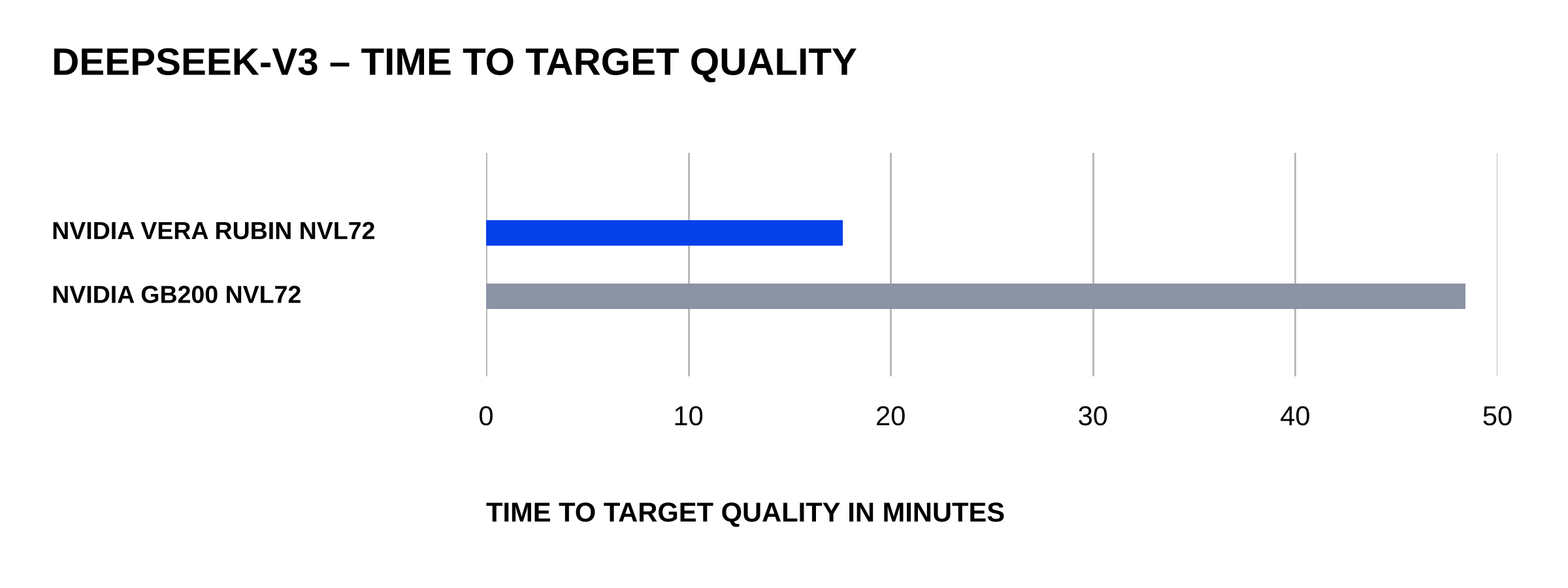
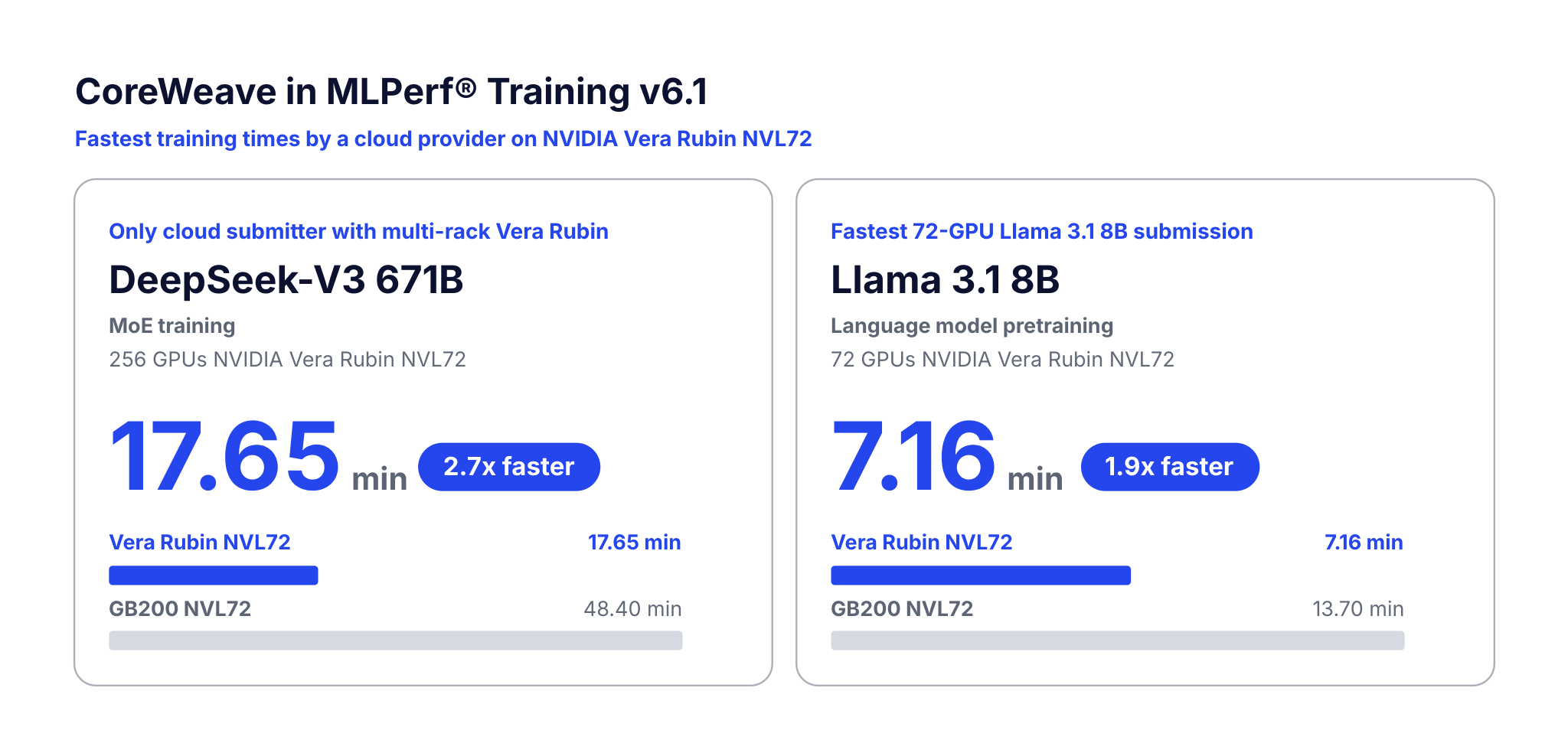
We trained DeepSeek-V3 671B to target quality in 17.65 minutes on 256 NVIDIA Rubin GPUs across four Vera Rubin NVL72 racks. At the same GPU count, our NVIDIA GB200 NVL72 submission took 48.40 minutes, a 2.7x improvement in time to train.¹ We were the only cloud provider to submit multi-rack Vera Rubin results in this round.²
This benchmark is especially relevant for teams training large MoE models. DeepSeek-V3 routes tokens between experts at every MoE layer, creating substantial communication demands across hundreds of GPUs. When training spans four racks, some of that traffic must cross the NVIDIA Spectrum-X Ethernet scale-out network fabric rather than remain within the NVIDIA NVLink™ domain. Accelerator performance translates into faster training only when the surrounding infrastructure minimizes communication overhead and keeps every GPU productive.
This is where CoreWeave’s full-stack engineering shows. We configure and operate high-performance networking, topology-aware workload placement, communication collectives, the software stack, and cluster operations as one integrated system. CoreWeave has Vera Rubin NVL72 running in production today, and customers can apply our full-stack engineering to large-scale training workloads across multiple racks.
CoreWeave achieved the fastest 72 GPU submission for Llama 3.1 8B
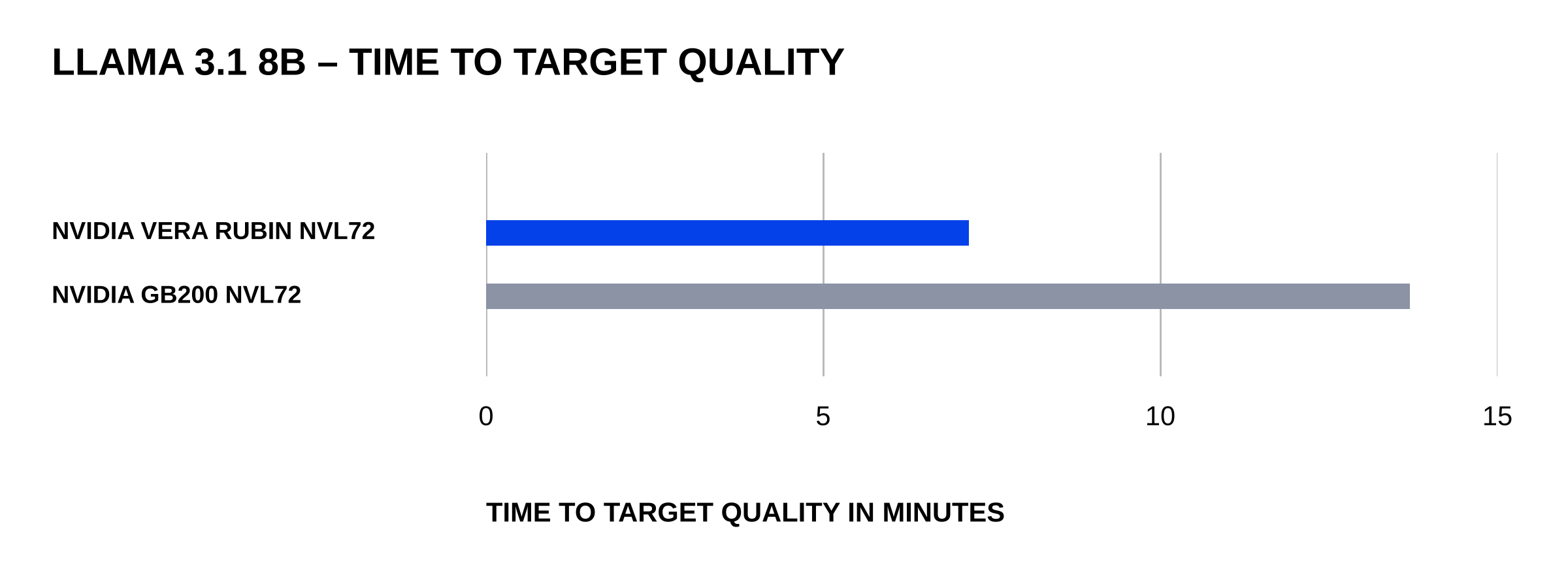
On a single rack of Vera Rubin NVL72, we reached target quality on Llama 3.1 8B in 7.16 minutes. That was the fastest 72 GPU submission in the round, and 1.9x faster than our 72 GPU NVIDIA GB200 NVL72 result of 13.70 minutes in the same round.¹ We used NVFP4 GEMMs, FP8 attention, and full NVIDIA CUDA™ graphs on both platforms.
This matters to teams that repeatedly train compact models. Llama 3.1 8B stands in for jobs like pretraining small dense models and continued training on domain data, where the number of runs a team finishes in a day sets how fast it learns. At 7.16 minutes, one rack could in principle complete eight back-to-back runs of this benchmark an hour, before startup and evaluation overhead.
In summary, Vera Rubin NVL72 in single and multi-rack configurations produced some of the strongest performance in the round with DeepSeek-V3 671B and Llama 3.1 8B.
Strong performance with GB200 NVL72 from GPT-OSS 20B pretraining to Qwen3.5 397B reinforcement learning
We completed Qwen3.5 397B reinforcement learning in 22.78 minutes on 256 GPUs across four racks, with 128 GPUs on training and 128 on generation, using NVIDIA NeMo and NVIDIA TensorRT-LLM. Reinforcement learning splits a cluster between training and generation, a different load pattern from pretraining.
These workloads represent different stages of model development. The GPT-OSS result demonstrates how quickly teams can train and iterate on a smaller open model within a single rack. The Qwen3.5 submission tests a much larger and more complex post-training workload, and it is MLPerf Training’s first large language model (LLM) post-training benchmark.³ Reinforcement learning must coordinate model generation, evaluation, and optimization across many GPUs, placing substantial demands on inference performance, data movement, workload scheduling, and the training stack.
CoreWeave’s full-stack optimizations deliver higher goodput
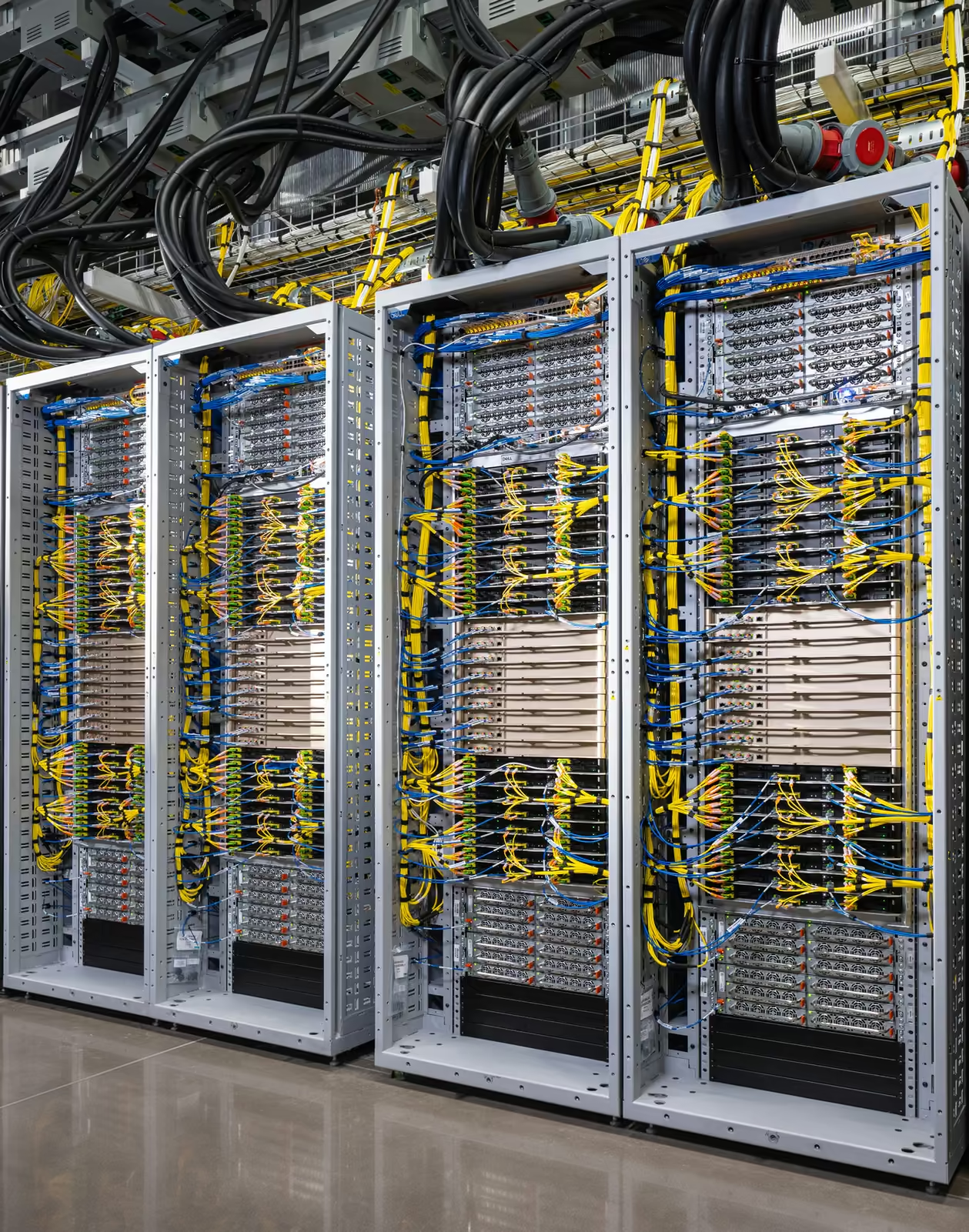
Advanced accelerators set the performance ceiling, but customers experience the system as a whole. Goodput depends on how effectively the infrastructure keeps GPUs doing useful work. CoreWeave designs and optimizes the full stack around AI workloads, bringing compute, networking, orchestration, software, and fleet operations together to reduce time to quality and sustain performance at scale.
We ran our MLPerf Training v6.1 benchmarks on NVIDIA Vera Rubin using the same production infrastructure foundation available to our customers. The results reflect more than accelerator speed. They demonstrate a system engineered to manage workload placement, isolation, monitoring, hardware lifecycle operations, and recovery while delivering production-scale performance. Read how we bring up multi-rack NVIDIA Vera Rubin NVL72 clusters.
At multi-rack scale, the network becomes critical to goodput. Distributed training loses efficiency whenever GPUs wait for data to cross the fabric. We connected the racks with a RoCE-based NVIDIA Spectrum-X™ Ethernet AI fabric (leveraging 102.4 Tb/s Spectrum-6 networking) and NVIDIA ConnectX™-9 SuperNICs, delivering the high-bandwidth, low-latency communication required to keep GPUs productive across rack boundaries.
CoreWeave Mission Control coordinates workload placement and operations across the cluster in addition to running Racky and Valvey for Vera Rubin rack and cooling management. Topology-aware orchestration accounts for GPU and network locality, while fleet health monitoring and lifecycle automation identify slow or unhealthy components before they reduce job performance. Across hundreds of GPUs, preventing a straggler or avoiding an interruption can preserve as much productive compute time as another software optimization.
These MLPerf Training v6.1 results show how CoreWeave performs at rack scale. On one rack, our Llama 3.1 8B run was the fastest 72-GPU submission,² and CoreWeave was the only cloud provider to submit multi-rack Vera Rubin results in this round.³ We combine NVIDIA’s industry-leading accelerated computing platform with purpose-built networking, topology-aware orchestration, an optimized software stack, and production-proven fleet operations to convert peak capability into sustained goodput. Customers can reach target quality faster, complete more experiments within the same development window, and get more useful work from every GPU-hour.
To learn more:
- Download the report on how MLPerf performance translates into total cost of ownership
- Join the webinar Engineered for Agentic AI: Exploring NVIDIA Vera Rubin on CoreWeave
- Watch The True Price of Intelligence: An Economic Study by Signal65
Results referenced: MLCommons® MLPerf® Training v6.1, Closed division, Available category, published November 16, 2026. See www.mlcommons.org for complete results.
¹ Speedups are derived by CoreWeave from published MLCommons results, comparing CoreWeave's Vera Rubin submissions with CoreWeave's GB200 NVL72 submissions at the same GPU count. Result not verified by MLCommons Association. The MLPerf® name and logo are registered and unregistered trademarks of MLCommons Association in the United States and other countries. All rights reserved. Unauthorized use is strictly prohibited.
² Based on CoreWeave’s analysis of published MLCommons MLPerf Training v6.1 Closed division results at the same accelerator count, as of November 16, 2026. Result not verified by MLCommons Association.
³ Based on MLCommons’ published description of the MLPerf Training v6.1 benchmark suite, as of November 16, 2026.