Security
IAM/SAM, compliance logging, audit.

Talent Services
Automated lifecycle control + direct-to-expert support.

Observability
Metrics, logs, telemetry, system signals.
Reliability
Transparency
Insight
CoreWeave Mission Control Agent


The industry’s first operating standard for running AI on CoreWeave Cloud that delivers reliability, transparency, and actionable insights.¹
CoreWeave Mission Control is central to how CoreWeave runs AI at production scale. It unifies security, expert-led operations and observability into one operating standard so your teams see clearly, act precisely, and run with confidence. CoreWeave Mission Control offloads node and cluster health management, audit delivery, and performance insight from your team to ours, delivering measurable reliability with up to 96% training goodput² and faster time to resolution. The CoreWeave Mission Control Agent integrates visibility directly into your workflow, helping teams rapidly diagnose issues and understand best next steps in real time.
CoreWeave Mission Control brings together security, talent services, and observability into one consistent way of running AI on CoreWeave Cloud. Together, these capabilities deliver three core benefits: reliability, transparency, and insight.
CoreWeave Mission Control brings reliability, transparency, and insight into one operating standard for AI at production scale.

CoreWeave Mission Control provides real-time visibility into cluster access and activity. Telemetry Relay forwards encrypted audit and security events to your SIEM, enabling governance, compliance reviews, and operational trust. With IAM, role-based access controls, and continuous audit delivery, CoreWeave Mission Control brings core security signals directly into your environment.
Every node is evaluated continuously to meet the performance demands of modern AI workloads. Fleet Lifecycle Controller tracks long-term GPU and node health, detects subtle degradation patterns, and replaces unhealthy nodes before they impact accuracy or throughput to maintain high reliability across the cluster.

CoreWeave Mission Control continuously monitors nodes for health regressions and replaces them automatically when thresholds are met. The Node Lifecycle Controller manages node health from initial deployment through the entire node lifecycle, minimizing interruptions, reducing wasted GPU hours, and keeping training and inference on track with predictable performance.
These controllers are designed and operated by CoreWeave’s Production Engineering team, who continuously evaluate fleet and node health at scale.
When customers need deeper assistance, direct-to-expert support routes requests to the same engineers who build and operate the platform to ensure fast, accurate resolution.

Mission Control unifies the signals that matter most—performance metrics, audit activity, workload behavior, and GPU-level anomalies—and turns them into immediate, actionable insight. With transparent telemetry, precise straggler detection, and a conversational AI assistant built directly into your workflow, teams can diagnose issues faster and keep large-scale AI running smoothly.
CoreWeave Mission Control provides unified visibility into GPU metrics, networking, storage, orchestration, and workload behavior. Teams can measure performance, diagnose issues, and recover jobs faster using consistent, correlated system signals surfaced in familiar, highly intuitive dashboards.
CoreWeave Mission Control’s observability layer, together with Telemetry Relay, provides real-time visibility into access, activity, and system behavior. Telemetry Relay delivers audit and access logs directly into your SIEM or monitoring tools, supporting governance, compliance reviews, and fast operational diagnosis.
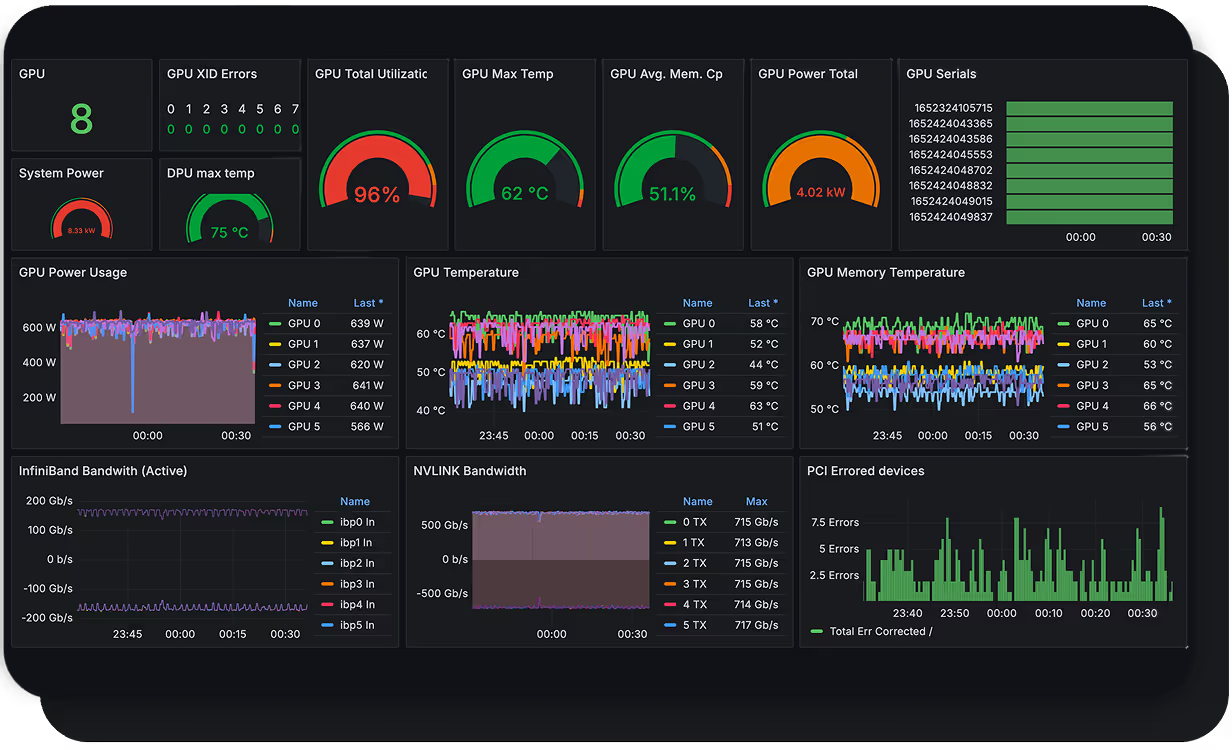
Distributed training does not fail gracefully. When one GPU lags, the entire job slows. CoreWeave Mission Control’s GPU Straggler Detection identifies the exact rank, GPU, and node causing slowdowns using signals from NVIDIA’s collective operations. Grafana overlays and alert recipes make root-cause identification fast and precise.
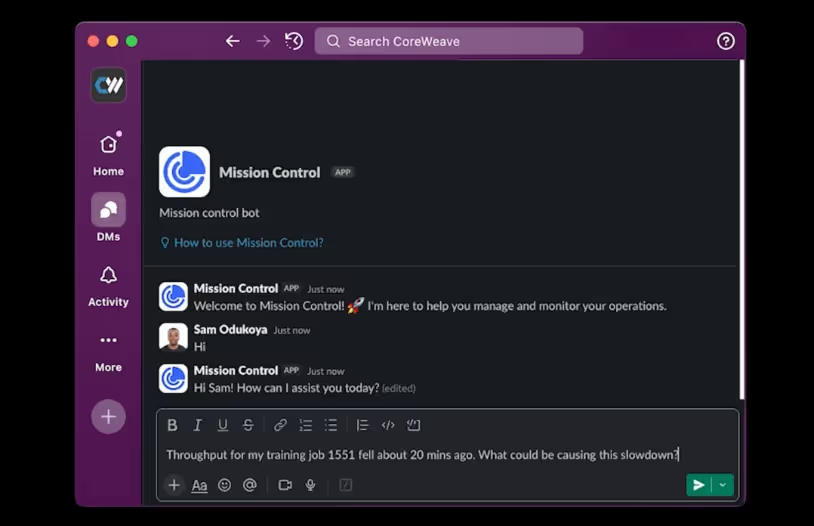
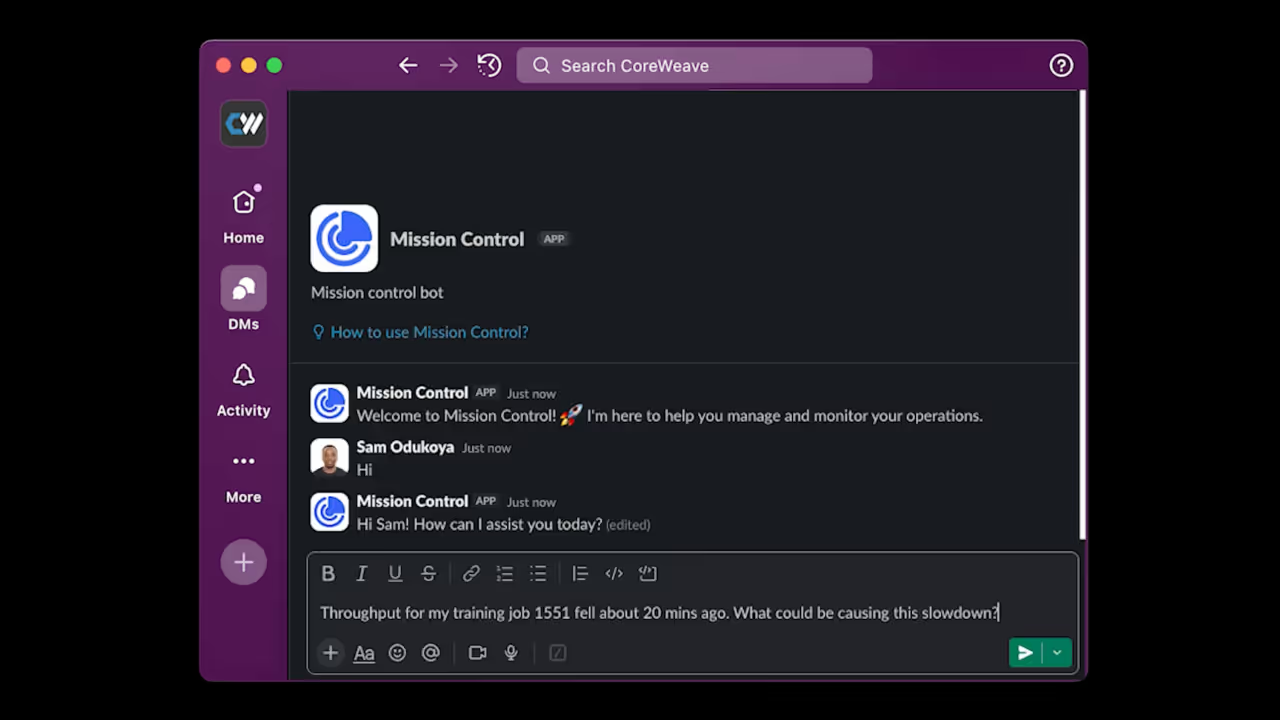
CoreWeave Mission Control now includes an interactive, conversational AI agent that assists engineers in real time. Ask questions about cluster health, job behavior, incidents, or what changed in your environment directly in Slack. The agent draws on CoreWeave Mission Control telemetry across infrastructure, workloads, and audit signals to help teams diagnose issues quickly and understand next steps.


¹The operating standard for AI is a set of functionalities that enables enterprise technology teams to run AI infrastructure so that it can consistently deliver on three objectives: reliability, transparency, and insights. These objectives and the related outcomes we deliver are described in more detail above and in our business blog post on December 9, 2025. When those are in place, even the most ambitious AI initiatives can run with confidence at massive scale.
²Goodput is defined as the amount of compute time spent doing meaningful work.