.avif)
For the last few years, teams have treated a model like a deliverable. Train it, eval it, ship it, frame the loss curve. Over and out.
That era is behind us. Launch is now closer to the beginning than the end. The moment a model or agent meets production, it starts generating the most valuable dataset you will ever own: evidence of how it actually behaves with real users, real edge cases, and real failures. The teams pulling ahead treat that evidence as fuel. They run it as a loop, and they run that loop as fast as they can, to ensure that they’ll bring the best model possible to their users or the broader market.
We call it the AI Loop. It's the framework behind everything CoreWeave and Weights & Biases are building together: training, inference, observability, evals, feedback, and improvement working as one system instead of a pile of tools you duct-tape together yourself and hold together with hope.
The loop, step by step
- Run: put the model or agent in front of real traffic, served through CoreWeave Inference, managed and serverless on CoreWeave GPUs, or on dedicated endpoints on CoreWeave Kubernetes Service (CKS)
- Observe: capture what actually happens with Weave traces and live scoring, while CoreWeave Mission Control watches the infrastructure underneath
- Curate: cluster the failures, edge cases, and user feedback into datasets worth learning from, versioned in Registry
- Improve: make the change, from a sharper prompt to post-training with CoreWeave Training on CKS or SUNK, tracked in W&B Models, with Automations handling the redeploy, proving it beats the version it replaces on quality, cost, and latency. Model improvement tactics include Serverless RL and Serverless SFT.
- Evaluate: turn those datasets into the eval set that defines what to fix, built with Weave Evaluations and run as the gate every candidate must pass
Then repeat. The loop doesn't finish: it continually compounds speed, response accuracy, and cost reduction.
Hope is never your eval strategy
The simplest path of the AI Loop is how agents improve: agents run, generate traces, get evaluated, receive feedback, and improve. Most of the improvement here never touches the model's weights. It may be simply a sharper prompt that delivers a better tool. Or maybe a tighter or new skill adapted to the end-user’s role. Or perhaps just keeping up with the cost/benefit of the latest and greatest model.
This work is faster, cheaper, and more valuable, and as you iterate, honing your agent’s behavior, you get to focus on your AI application and let the platform handle the infrastructure. If it’s dependable and consistently performant, you take it as a given. Then, once your agents are in production and nobody is reading the traces, you're not debugging, you're holding a séance. Weave exists so that the reading actually happens: every call traced, every output scored, online evaluations running against live traffic instead of your best guesses.
So yes: everyone in the industry building an AI application should be improving their agent loop, continuously. It's the minimum standard of care for production AI. Which is exactly why it won't differentiate you for long. When everyone runs the same agent loop on the same frontier models, everyone converges on the same ceiling.
Going deeper: the model training loop
In addition to the agentic AI loop, there’s a deeper, more intricate loop: post-training. Fine-tuning on your curated failures. Reinforcement learning against evals built from your own production traffic. Changing the weights themselves.
This is the differentiator for technically rigorous enterprises. Not access to models, which everyone has. Not clever prompting, which everyone will copy. The ability to close the loop all the way down to the weights, repeatedly, with proof. (And agents can help here, too.)
Most organizations stop at the prompt layer, because the deeper model loop demands things a prompt never will: training compute sitting next to inference, isolated execution for reward verification and agentic rollouts (CoreWeave Sandboxes), evals rigorous enough to act as gates, and the discipline to prove a candidate beats the incumbent before it takes traffic. That barrier is lower than it used to be. CoreWeave Training runs serverless reinforcement learning and serverless fine-tuning without asking you to stand up a training cluster, and when your ambitions outgrow serverless, CKS and SUNK give you the same clusters we run frontier training on. (And we’re proud to serve 9 out of 10 frontier labs.)
First, in capability. Prompt improvements asymptote. Weight improvements compound, and your proprietary failure data becomes an advantage baked into the model itself, where no competitor can copy-paste it.
Second, in economics and performance. A model post-trained for your task can beat a larger prompted one on cost and latency, and because CoreWeave runs training and inference on the same bare-metal platform, the improvement shows up as a number: dollars and milliseconds, not vibes (although it results in pretty good vibes).
You can't improve what you can't see
Observability in the loop has two levels of depth, and teams routinely confuse them. There’s success/failure rates at the query-and-response layer, and then there’s infra, which also might fail or succeed on any given prompt.
Weave tells you what your agent did: the trace, the tool calls, the score against your evals. Mission Control tells you what your infrastructure did: GPU, network, and storage behavior in real time, straggler detection down to the individual GPU slowing a distributed job, unhealthy nodes replaced before you notice them. Clusters that are run this way sustain up to 96% goodput, which matters because a faster, healthier model loop is the entire point.
When something breaks at 3am, the first question is always which layer. With both in one platform, you stop guessing.
The AI loop gets an orchestrator
AI loops don't run themselves. Someone has to read the runs, form the hypothesis, launch the experiment, and judge the result, and that someone has historically been your most expensive researcher doing their least favorite work.
CoreWeave ARIA, our AI Research and Iteration Agent, is that orchestrator. Today, in public preview, ARIA analyzes thousands of runs and tens of thousands of metrics across your experiment data in Weights & Biases, uncovers the patterns driving performance, forms hypotheses, launches experiments, evaluates the results, and recommends the next move, without manual orchestration. ARIA is also an agent whose job is improving your models and agents. We built it with Weave, using detailed data produced by extensive internal employee usage. This serves as a baseline, upon which, ARIA improves through the same loop it runs.
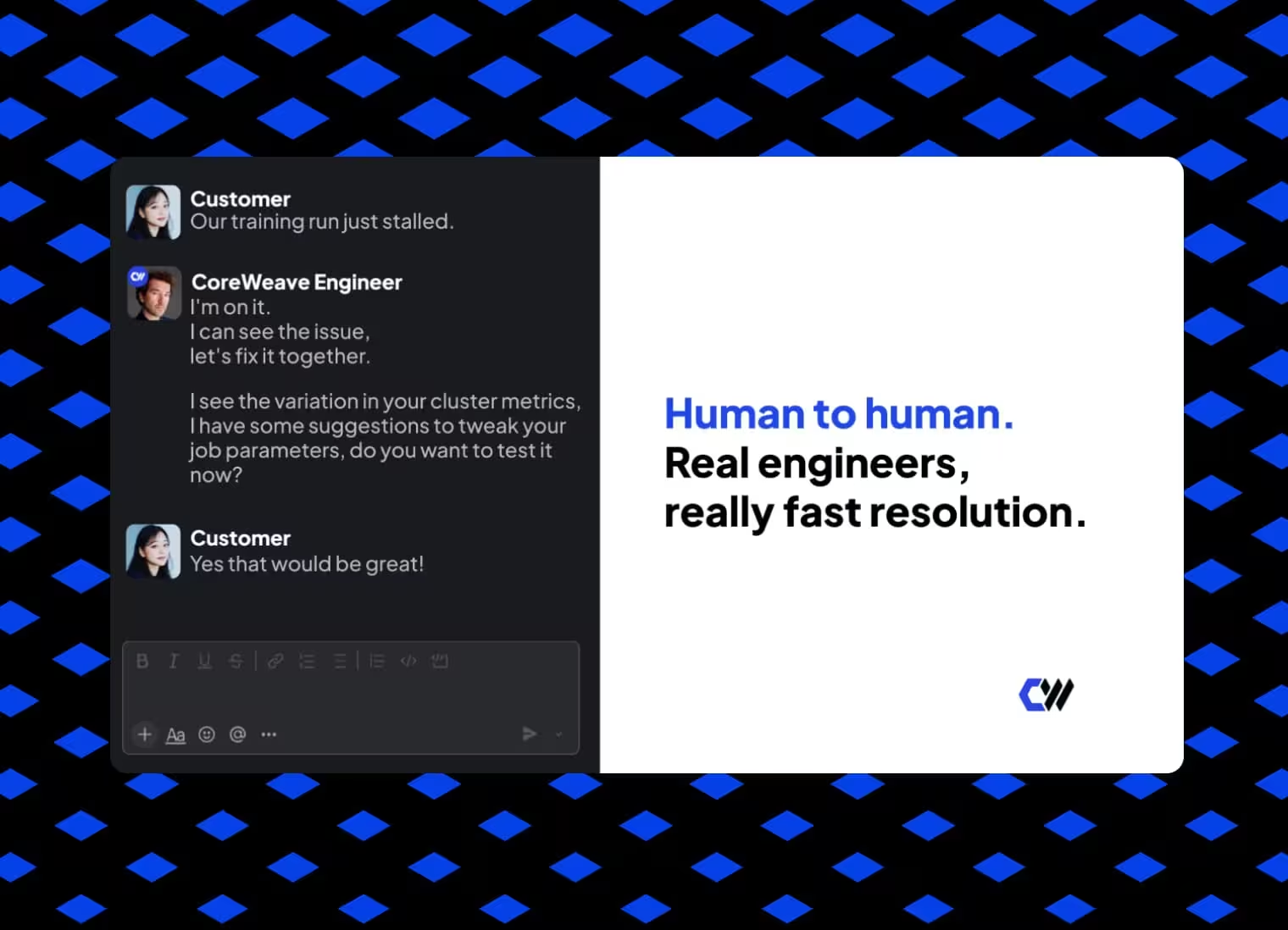
Today we’re already comprehensively connecting the dots for our customers, and we're always looking to remove more roadblocks so you can focus on business outcomes and not wasting time on workarounds for stalls, crashes, and cryptic error messages.
An AI loop you can't replay is just an anecdote
None of this holds together without receipts. Across every step, Registry and lineage keep a versioned record of what changed: every model, prompt, dataset, eval, and guardrail. That record is what lets you trace a regression to its cause, reproduce a win, and repeat the loop with confidence instead of folklore. It's quietly one of the strongest things the platform offers.
Compounding is the whole game
Where you enter the AI loop depends on what you build. For models, much of the improvement happens before launch, so the deeper loop dominates. For agents, most of the learning comes from production, so they stick to optimizing the prompt and harness. Everyone should be spinning the agentic loop. The technically rigorous will close the model loop as well. CoreWeave and Weights & Biases are building the single foundation for both, on the Essential Cloud for AI.
Start where you want to see the biggest gains today:
- Deploy on Serverless Inference: pay-per-token serving, no cluster to stand up
- Trace your agents in Weave: every call traced, every output scored
- See Mission Control: GPU, network, and storage behavior in real time
- Try ARIA in preview: put an agent on the research side of your loop
- Deploy Reliable Agents at Scale: learn how to make agents reliable with RL