For the past few years, much of the AI conversation has focused on getting models to produce useful outputs. But useful output is only the starting point. As organizations move from proof-of-concept to production, the stakes rise: outputs must not only be accurate and valuable, they must also meet real-world requirements for latency, reliability, and cost.
As AI becomes embedded in customer-facing applications, agentic workflows, copilots, search experiences, recommendation engines, and core business processes, the central question is “How do we operationalize models at scale?”
That question leads directly to inference. Once viewed primarily as the serving layer that sits downstream of model development, inference has become the operational backbone of AI. It is where applications generate value, consume infrastructure capacity, and expose performance and business risk.
In his 2026 GTC keynote, Jensen Huang noted the inference inflection has arrived—framing inference as one of the hardest problems in AI because every response, reasoning step, and agent action depends on inference behaving predictably at production scale.
The challenge is not just technical: Deloitte notes that while inference costs continue to fall, enterprise spending on inference is rising because AI adoption and usage are growing even faster. Inference is increasingly a return on investment question, not just a model deployment problem.
As AI scales, success depends less on the cost of a single inference request and more on whether an inference platform can keep workloads fast, reliable, efficient, and controllable in production.
Inference is the ultimate hard problem
As AI applications become more capable, interactive, and autonomous, they place heavier and more variable demands on inference. What was once a relatively straightforward request-response pattern is evolving into a continuous stream of reasoning, tool execution, validation, and generation.
Agentic workflows are the clearest example of rising inference demand. A single workflow involves planning, reasoning, tool use, validation, and response generation. Each step triggers additional inference calls, and increases latency, utilization, and cost as agents execute tasks end-to-end.
The same demands on inference extend beyond agents. Copilot-style assistants, real-time search, recommendation engines, and multimodal applications all rely on inference solutions that must remain responsive, reliable, and economically predictable as usage scales.
What production-grade inference needs to provide
As inference becomes central to application performance, user experience, and operating costs, choosing the right solution becomes a more complex strategic decision than just defining deployment details. That decision entails tuning for the right level of performance, cost and control needed for each workload. Teams need an inference solution that can stay reliable under variable traffic loads, make costs predictable as usage scales, and give them enough control to tune, optimize, and evolve over time.
Reliability comes from infrastructure
Production inference performance depends on the end-to-end infrastructure running the workload and the visibility into how it behaves. NVIDIA's performance-per-watt data illustrates the scale of the impact: moving from NVIDIA Hopper to NVIDIA Blackwell Ultra delivered up to 50x higher throughput per megawatt and 35x lower token cost for DeepSeek-R1 workloads. That trajectory continues with NVIDIA Vera Rubin NVL72, which delivers up to 10x better inference per watt and one-tenth the cost per million tokens compared to Blackwell. Every new hardware generation delivers improvements in throughput, latency, and cost efficiency and sets a new ceiling for what is achievable.
Visibility into workload behavior is what makes sustained optimizations possible. As workloads become more complex, teams need insight into latency, throughput, utilization, scaling behavior, and cost drivers to understand how inference systems are actually performing in production. Without that visibility, teams can see the symptoms—responses slowing, throughput falling, costs drifting—but not the infrastructure behavior driving those outcomes. When teams can connect symptoms to causes, they can diagnose issues faster, validate scaling assumptions, and optimize performance before users are affected.
Cost predictability matters as much as cost
Token pricing has become the go-to pricing model for inference because it turns usage into a clean, comparable unit. That makes it useful for experimentation and variable demand, but it also means costs move with workload behavior.
As inference volume grows, that variability can become harder to forecast and manage. Traffic patterns shift, context lengths expand, and agentic workflows can trigger multiple inference calls per task. The result is a bill that may grow in ways that are difficult to connect back to specific application behavior.
At some point, the question shifts from “What is the cheapest token?” to “What is the right economic model for this workload?”
The answer depends on volume, traffic shape, performance requirements, and how much cost predictability the business needs. Variable or exploratory workloads may benefit from usage-based pricing, while steady, high-volume, or performance-sensitive workloads may reach a point where dedicated capacity provides better economics and more predictable spend. In production, the pricing model matters as much as the price because cost efficiency depends on matching infrastructure economics to how the workload actually runs.
Control that evolves with the workload
As workloads mature, organizations also need greater control over how inference is deployed, scaled, and optimized. When the inference layer behaves like a closed box, operations become reactive: teams can observe symptoms, but they have limited ability to understand or influence the system’s behavior.
The abstraction that made it easy to start experimenting becomes the thing that limits what teams can see, tune, and control in production. By the time those limitations become operationally significant, moving to a different foundation may require rebuilding deployment patterns, observability workflows, cost models, and operational processes, not simply changing a configuration.
Production requirements change over time. What begins as a simple deployment may evolve into a multi-model application, an agentic workflow, or a business-critical service with strict latency and availability targets. A production-grade platform should allow organizations to increase operational control as those requirements mature, without forcing disruptive migrations or architectural redesigns.
Build around workload fit
Production AI workloads do not all require the same operating model. Early-stage applications often prioritize speed, flexibility, and low operational overhead, while mature production workloads may require greater performance predictability, cost control, and infrastructure ownership. The ultimate challenge is matching the needs of the application to the right level of abstraction, pricing model and operational responsibility.
That's the standard production inference should be held to, and what the right infrastructure partner is built around.
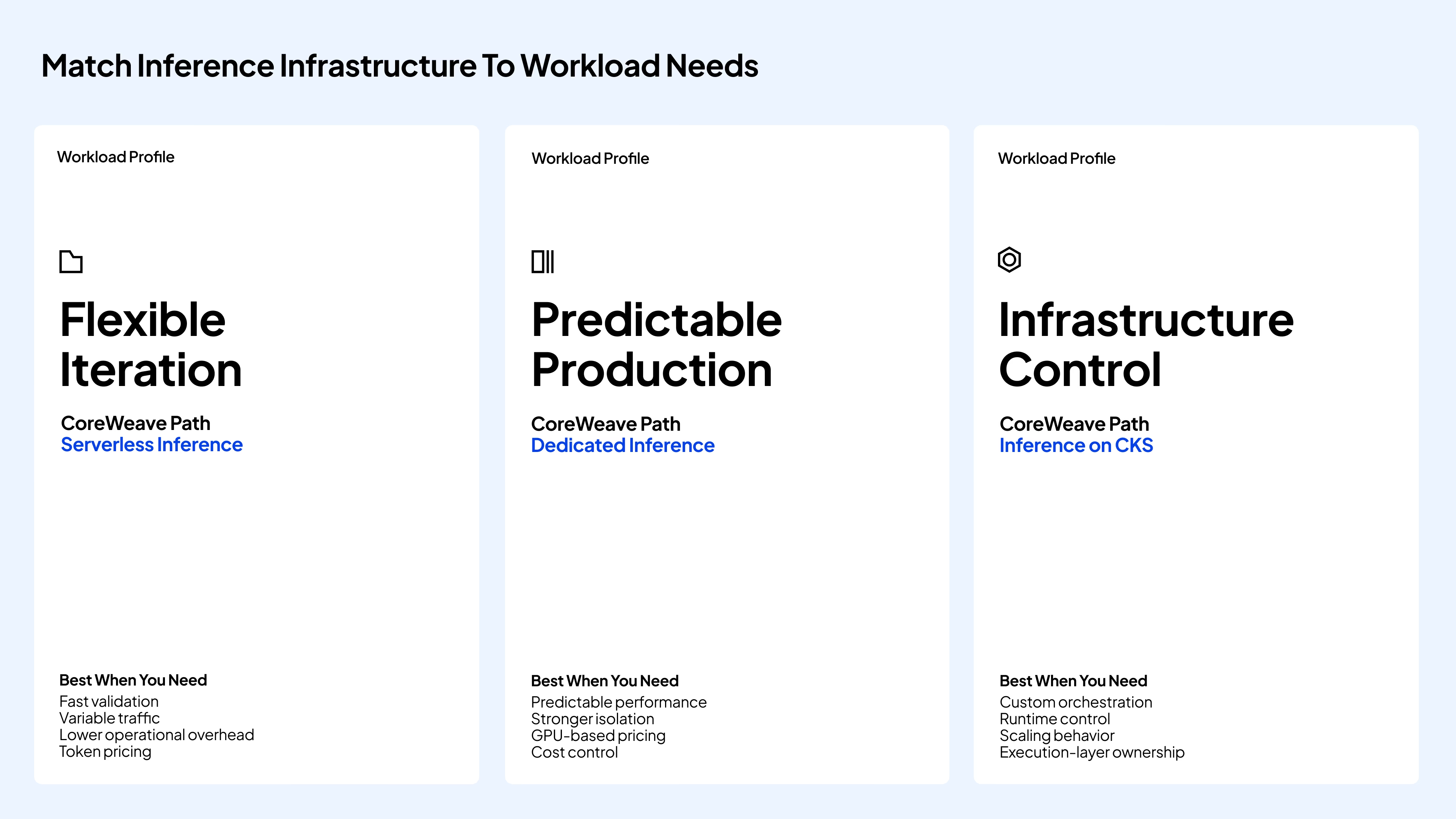
CoreWeave Inference is built around workload fit, offering three distinct deployment paths:
- Serverless Inference—for teams prioritizing speed and simplicity. Deploy leading open-source models via API with built-in model-level observability and automatic scaling, and no infrastructure to manage. Token-based pricing keeps costs variable and easy to forecast.
- Dedicated Inference—for workloads where price-performance predictability and customization matter. Bring your own model weights, select your GPU type and serving runtime, and run on capacity reserved for your workload, while CoreWeave handles production operations and provides visibility into cost and performance behavior. GPU-based pricing delivers more predictable economics as volume scales.
- Inference on CoreWeave Kubernetes Service—for teams that need full infrastructure ownership. Self-host models, runtimes, and orchestration on CKS with complete control over configuration, scaling behavior, and execution environments, backed by end-to-end observability and access to the full range of capacity options including reserved, on-demand, spot, and flex.
All three are built on CoreWeave’s full-stack infrastructure platform, spanning compute, networking, storage, memory, orchestration, interconnects, cooling, and serving software, all optimized for AI inference. CoreWeave was among the first to deploy each new generation of NVIDIA infrastructure—including Blackwell, Blackwell Ultra and now Vera Rubin—enabling access to generational performance and efficiency gains before they become widely available. Optimizations at every layer of the stack help teams achieve better and more predictable performance.
Deep observability is built-in at every layer through Weave for model-level observability and Mission Control for infrastructure-level observability. This provides teams visibility from infrastructure consumption to model behavior: no closed boxes between what the model produces and how infrastructure is consumed to produce it.
The three paths also allow organizations to match the economic model to the workload, from token pricing to dedicated GPU capacity. Teams can start from variable consumption and scale up to reserved capacity as requirements evolve without sacrificing visibility, performance, or operational continuity.
The strength of CoreWeave’s infrastructure foundation is demonstrated both by independent validation and performance benchmark results. CoreWeave’s designation as an NVIDIA Exemplar Cloud and its SemiAnalysis ClusterMAX Platinum-tier rating reflect broader full-stack infrastructure strength across compute, networking, orchestration, and scaling performance. In MLPerf 6.0, CoreWeave demonstrated leading DeepSeek R1 inference performance on NVIDIA GB200 NVL72 systems across both server and offline benchmarks, while the Artificial Analysis benchmarking for Kimi K2.6 highlighted CoreWeave as one of the top providers for inference speed and price-performance.
A readiness check for production inference
The next breakout AI products will be defined by inference that stays fast, reliable, cost-efficient, and controllable under live traffic. The right infrastructure foundation enables organizations to adapt operating models, optimize economics, and scale performance while maintaining continuity across every stage of the AI lifecycle.
Not every workload requires the same approach. The right inference solution depends on your performance requirements, traffic patterns, operational needs, and cost objectives.
CoreWeave Inference is built for this.
Meet with a CoreWeave Inference specialist to assess your workload and determine the deployment model that best aligns with your production goals.
Book now →
The executive brief, Inference Is Your Product's Reliability Layer, breaks down how reliability, cost, and control behave under production inference demand—and what purpose-built infrastructure does about it.
Read the executive brief →